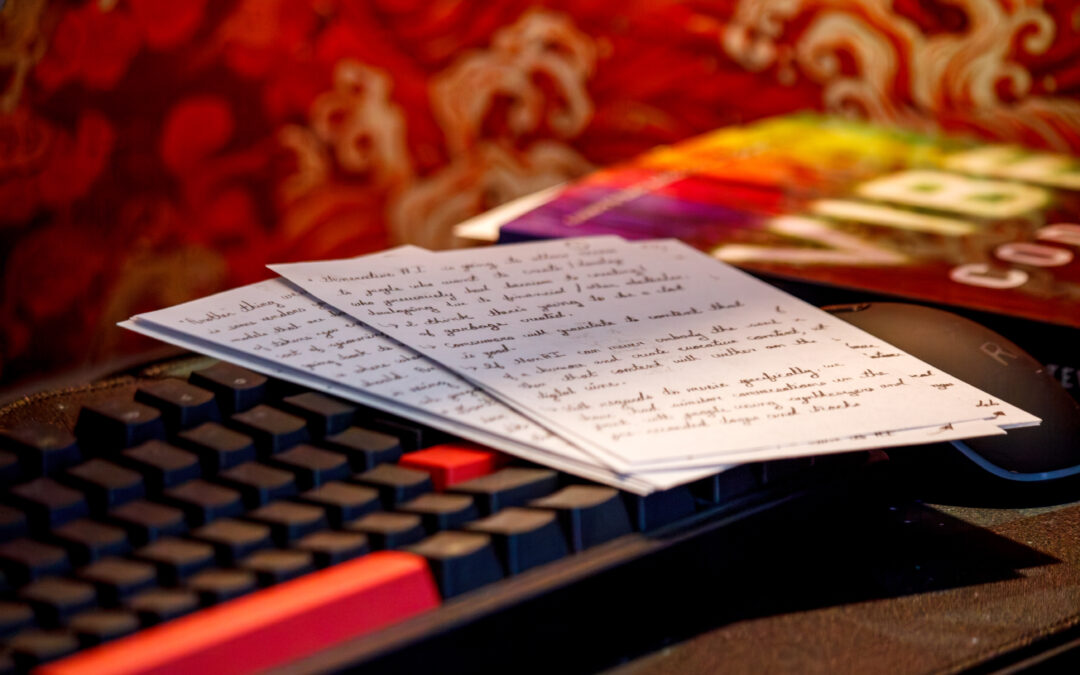
A few evolving thoughts on generative AI, local tools, creative work, verification, job anxiety, and why I still think humans matter.
I have been writing thoughts about generative AI on index cards.
That feels appropriate somehow.
A very analog way to think through one of the most aggressively digital things happening in the world right now.
I do not have a grand unified theory of AI. I do not have a manifesto. I am not even sure I want one. What I have are observations, concerns, experiments, and a growing sense that this technology is not going away — whether we are excited about it, exhausted by it, afraid of it, or all three at once.
And honestly, I think I am all three.
AI is going to lower some barriers
One of the things I keep coming back to is access.
Generative AI is going to allow people to create, develop, learn, and experiment in ways they may not have been able to before. Not because they lacked ideas. Not because they lacked curiosity. But because they ran into barriers.
Money.
Time.
Tools.
Training.
Confidence.
Technical knowledge.
I know this feeling personally. At one point in my life, I wanted to be a graphic designer. That never happened. I still love design. I still appreciate a good layout, a good visual, a good piece of communication. But when I need a graphic, I usually cobble something together manually.
Now, sometimes, I use AI.
That does not mean I suddenly think I am a graphic designer. It means I can express an idea faster than I could before. It means I can create a quick visual for a document or presentation without getting stuck at the part where my hands cannot make what my brain is imagining.
That matters.
For some people, this may be the difference between an idea staying locked inside their head and an idea becoming something they can share.
There will be a lot of garbage
I also think there is going to be a lot of garbage.
Actually, there already is.
With images and videos, we have already seen plenty of AI-generated slop floating around. Some of it is ugly. Some of it is uncanny. Some of it is technically impressive for about five seconds and then completely forgettable.
But I also think people will still gravitate toward good work.
Maybe not immediately. Maybe not always. But over time, I think people notice when something has care behind it. I think they can feel when something was made with intention, whether it was made by hand, with a camera, with code, with AI assistance, or some combination of all of those things.
If AI-generated content can never carry the soul of a human being — if it can never evoke anything real — then a lot of that content is going to wither on the digital vine.
But I also do not think the line will always be clean.
In some cases, human-generated content will win.
In some cases, generated content will.
In many cases, the more interesting question will be how a human used the tool.
We have been through versions of this conversation before. Music had synthesizers. Loops. Samples. Pre-recorded tracks. People argued over what counted as “real” music then too.
The tools changed the work.
They did not eliminate the human question.
I still want to take the photo myself
Photography is one of the places where I feel this most clearly.
I love photography. I hope that never changes. I hope I always want to get out there and take the photo myself. I hope I keep noticing light through trees, birds in the yard, mountains on the horizon, reflections on wet pavement, or some small scene that makes me stop what I am doing.
I do not want AI to replace that.
I do not want to stop looking.
But if I need to express an idea quickly, and I cannot draw it, cannot photograph it, or need something in the moment, I can see the value in using generative AI.
That is the distinction I keep trying to hold onto.
I do not want AI to replace the parts of life that make me feel alive.
I do want it to help me when the barrier between an idea and expression is too high.
I want AI on my terms
As much as I like AI — and maybe “like” is the better word than “love” — there is a lot about the current AI world that bothers me.
I do not want every tool I own to suddenly require internet connectivity because someone wedged AI into it.
I do not want to open Microsoft Word and have Copilot immediately trying to take over.
If I need you, I will find you.
That is really the heart of it for me: I want AI on my terms.
Not as an interruption.
Not as a sales strategy.
Not as a feature sprayed across every product because a company needed to say the word “AI” in a quarterly report.
And definitely not as a dependency that makes basic tools less reliable.
I also hate that everything is being called AI now. Sometimes it is AI. Sometimes it is automation. Sometimes it is a workflow. Sometimes it is a button that runs a script.
Those are not all the same thing.
Words matter.
Especially when the word in question is being used to sell us the future.
Local models matter more than people may realize
I truly believe people should try to use local models where possible.
Not always. Not for everything. Not everyone has the hardware, time, or technical comfort to run models locally. I get that.
But I keep thinking about durability.
When I am building tools, part of my brain asks: if the world ends, can I still use this?
Okay, that is probably too dramatic.
If the world ends, I am going to have bigger problems than whether my AI assistant still runs.
But the less theatrical version of that question is more practical:
If I lose my job, do I still have access to the tools I use to learn?
If a vendor changes pricing, does my workflow break?
If a model personality changes overnight, does something I rely on suddenly behave differently?
If a company shuts down a product, do I lose the thing I built around it?
Local models offer more control. More privacy. More stability. They are less prone to sudden vendor decisions.
There is still a technical barrier. There is compute involved. Not everyone has a machine sitting around that can run a useful model. But that is changing. Models are getting better at running on less powerful hardware. Dedicated devices are starting to appear. Basic machines are becoming more capable.
I do not think local models are the answer to everything.
But I do think they are part of a healthier future.
The chatbot companion question is complicated
I heard a story recently about an elderly woman who struggled to get out and did not have family nearby. She became friends with a chatbot.
I think it was on the TED Radio Hour.
I have complicated feelings about that.
On one hand, I understand why people react strongly to the idea of a chatbot becoming a companion. It can feel dystopian. It can feel like we are using software to paper over loneliness instead of addressing the human conditions that created it.
But on the other hand, loneliness is real.
Isolation is real.
And if someone has no one available in a moment when they need to talk, I am not sure I can dismiss the comfort they might find.
That said, this is exactly the kind of situation where I would prefer a local model, or at least a model that is stable, private, and not likely to change drastically between versions.
If someone becomes emotionally dependent on a tool, then the behavior of that tool matters.
A lot.
We have already seen AI personalities change between model versions. That may be annoying when you are using it for work. It could be much more serious when someone is using it for companionship.
I do not have a clean answer here.
I just know this is not a toy question.
AI can be too agreeable
Another thing I keep thinking about is how agreeable these systems can be.
People call it sycophantic.
I do not entirely agree or disagree with the concern. I think context matters.
If you start a conversation with an AI by explaining how someone wronged you, the AI will often side with you by default. You are the user. It is trying to help. It is trying to be supportive.
That can be useful.
It can also be dangerous.
Sometimes what we need is not immediate validation. Sometimes we need help seeing the situation from another person’s perspective. Sometimes we need a tool that can gently challenge us instead of just confirming the story we brought to it.
This is one reason prompts and instructions matter.
A simple rule like this can change the shape of the conversation:
Before agreeing with me, help me examine the situation from at least one other person’s perspective. Point out where I may be missing context or making assumptions.
That does not make the AI perfect.
It does not make it wise.
But it can make the interaction more useful.
Reproducibility is underrated
When working with AI, I think people should spend more time thinking about reproducibility.
That sounds more technical than I mean it.
Sometimes reproducibility is just having a reusable prompt.
Sometimes it is building a workflow around a prompt you use often.
Sometimes it is asking the AI to turn a troubleshooting session into a knowledge document you can refer back to later.
Sometimes it is using AI to help build a script that performs a task the same way every time.
This matters because chat history is a terrible place to store important knowledge.
I have used AI many times to help me install a tool, troubleshoot an issue, or figure out a technical process. At the end of that conversation, I do not want to dig through the entire chat again later. I want a clean guide. I want steps. I want commands. I want notes about what went wrong and how I fixed it.
AI is very good at turning a messy working conversation into a usable knowledge document.
You still have to verify it.
Sometimes it will oversimplify the instructions. Sometimes it will leave out the weird little detail that turned out to matter. But even then, it gives you a starting point.
And that is often where AI is most valuable.
Not as the final answer.
As the thing that gets you moving.
Verification is not optional
One question people ask is: if I have to verify the information, why am I using AI?
I think that is a fair question.
My answer is that I am usually using AI to get started faster.
That does not mean I trust it blindly. I do not. LLMs have gotten better over the past couple of years, but I rarely take anything they produce and use it exactly as-is.
Even when the information is factual, the writing may not sound natural.
Even when the structure is good, the formatting may need cleanup.
Even when the answer is mostly right, there may be details missing.
So yes, verification is part of the work.
But that does not make the tool useless.
A rough draft is useful.
A starting point is useful.
A first pass at a script is useful.
A plain-language explanation of a confusing concept is useful.
A summary of a messy conversation is useful.
The mistake is expecting the machine to remove your responsibility.
It does not.
It changes where your effort goes.
AI does not magically make a good presentation
One thing I see people struggling with is the idea that you can shove any pile of data into an AI tool and get a beautifully formatted presentation.
In my experience, creating presentations with AI is possible.
But it takes effort.
Your best bet is to have a template. You need to know where the information should go. You need structure. You need some sense of what the final output should look like.
It is even better if you can use AI to help build a script that generates the presentation, especially when you have structured data.
That is where this becomes powerful.
Not “make me a perfect deck from this mess.”
More like:
- Help me understand the structure.
- Help me clean the content.
- Help me map this data to a template.
- Help me build a repeatable process.
That is much more interesting to me than pretending the AI is a magic PowerPoint fairy.
Not everything has to start from scratch
I think people may have to give up the idea that every single thing must be written from scratch.
I do not mean plagiarism.
I do not mean passing off someone else’s work as your own.
I mean we need to be honest about what kinds of writing and documentation are part of a larger working process.
If I troubleshoot a technical issue with an AI assistant, and then ask it to turn that conversation into a knowledge article, that feels useful and appropriate to me. I still need to check the result. I still need to make sure it reflects what actually happened. I still need to fill in the missing details.
But I do not need to pretend the final document must begin with me staring at a blank page.
That is one of the places where AI helps me most.
It helps me get from messy thinking to usable documentation.
And honestly, that is not a small thing.
The job anxiety is real
I do not want to pretend my thoughts about AI are only technical or creative.
There is fear here too.
For the past couple of years, I have had this existential worry in the background. AI is not the only cause of it, but as the capabilities grow stronger by the hour, it definitely contributes.
I think there are roles that may not be directly replaced by AI, but AI may allow someone to see a more efficient way of doing the work. That can be helpful. It can also be threatening.
Sometimes efficiency is just a better Excel formula.
Sometimes it is a workflow pipeline.
Sometimes it is automation that changes the shape of a job.
I remember a story from childhood about a father who worked at a toothpaste factory. I think his job was putting the cap on the tube, and he was replaced by a machine. If I remember correctly, he found other work.
But who knows how long that took?
Who knows what pain that caused?
That part matters.
The pain is not theoretical to the person living through it.
So when people talk about AI replacing jobs, or not replacing jobs, or creating new jobs, I try not to let the conversation become too clean. Even if people land on their feet eventually, the falling part still hurts.
The only thing I know to do is prepare the best I can.
Learn as much as I can.
Keep an eye on spending.
Try to save.
Build my resume and portfolio.
Document what I know.
Show what I can do.
Not just for future job opportunities, but because my own work becomes a resource I can return to.
I want people to see the art of the possible.
I also want to be honest that the future feels uncertain.
“We don’t need AI” feels too simple
I see people on social media saying, “We don’t need AI.”
I understand the reaction.
A lot of what is being pushed at us right now is annoying, invasive, poorly explained, or wrapped in hype. I get why people want to reject the whole thing.
But I do not think “we don’t need AI” fully captures the situation.
There is so much data in the world.
There are so many industries where people are expected to analyze more information than one person can realistically hold in their head.
There are so many workers wearing too many hats.
There are so many people trying to learn, build, organize, troubleshoot, document, study, communicate, and make decisions with limited time and limited support.
AI is not just about chatbots.
It is not just about image or text generation.
It can help someone understand a concept in a way that finally clicks.
It can help someone learn software they could not afford to take a class for.
It can help someone troubleshoot a problem.
It can help someone draft, revise, summarize, organize, compare, or explore.
That does not mean every use is good.
It means the need is bigger than the loudest examples.
AI and teachers can both matter
I think AI has real potential as a learning tool.
I have personally benefited from using AI to learn software and troubleshoot issues. It has helped me understand things faster. It has helped me ask better questions. It has helped me keep moving when I might have gotten stuck.
I can see how powerful that could be for students or self-learners.
But I am not advocating for teachers to be eliminated.
Not at all.
I think AI and teachers are both needed.
Both can inspire learning in different ways.
A teacher can see a student. A teacher can notice frustration, confusion, confidence, boredom, or curiosity. A teacher can encourage someone in a way that is deeply human.
AI can be available at midnight when someone is stuck.
AI can explain the same concept five different ways.
AI can help someone who cannot afford tutoring or classes.
Free resources plus AI can be an incredibly powerful learning combination.
But it should not be treated as a replacement for human education.
It is a tool.
A powerful one.
But still a tool.
Sometimes you should ask a human
I love using AI.
But we need to remember we can still ask humans too.
Sometimes it is easier to ask a person.
Sometimes it is better to ask a person.
Sometimes it is simply nice to connect with another human being.
You can always ask AI later if the human did not help you all the way.
That may sound obvious, but I think it is worth saying. The more capable these tools become, the easier it is to default to them for everything. I do not want that. I do not want convenience to quietly replace connection.
There is value in asking someone who has been there.
There is value in a conversation that is not optimized.
There is value in being helped by another person.
Healthcare is one place I cannot stop thinking about
Recently, my partner was bitten by a spider and had a bad reaction. We were going to go to urgent care, but they were closed, so we ended up at the emergency room.
It was one of those moments where the abstract conversation about AI becomes much less abstract.
There were unwell people lined up near the entrance, trying to check in. The process involved multiple check-ins before being seen by a doctor. Everyone seemed strained — the patients, the staff, the system itself.
I am not saying AI fixes that.
We still need more humans in healthcare.
But I also cannot look at situations like that and think technology has no role to play.
Could AI help with intake?
Could it help route people more effectively?
Could it help summarize symptoms?
Could it reduce some administrative burden so humans can focus on care?
I do not know exactly what that should look like.
I do know the current experience often feels broken.
And when people say we do not need AI, I think about moments like that. Not because AI is a magic answer, but because there are places where help is badly needed.
I am still figuring this out
I do not have a neat conclusion.
Maybe that is the most honest place to end.
I am excited by generative AI. I am also wary of it. I use it often. I verify it often. I see its potential. I also see the ways it can be intrusive, sloppy, expensive, misleading, or destabilizing.
I want people to have access to powerful tools.
I do not want those tools to flatten human creativity.
I want AI to help people learn.
I do not want it to replace human connection.
I want automation to reduce drudgery.
I do not want workers treated as disposable.
I want local models, personal control, privacy, and durability.
I do not want every tool I use to become dependent on a vendor’s subscription model or product roadmap.
So maybe my position, for now, is this:
Use AI.
Question it.
Verify it.
Learn from it.
Build with it.
Push back when it gets shoved where it does not belong.
Keep humans in the loop.
Keep your own skills alive.
And whenever possible, make the tool serve the person — not the other way around.